
How Much Does It Cost to Open a Gym?
How Much Does It Cost to Open a Gym?

Opening a gym in 2026 costs anywhere from roughly $25,000 for a lean personal training studio to more than $900,000 for a full franchise location, and equipment typically accounts for 25–60% of that number depending on your format. That is the honest short answer, and the rest of this guide breaks it down line by line so you can build a budget you actually trust.
A word on who is writing this. We are a commercial gym equipment factory, which means we sit at a specific vantage point in your startup budget: the equipment line. Every week we quote and ship orders for exactly the projects this article describes, from single-room PT studios to full independent gyms, so the equipment figures below are not scraped from other blogs. They come from our own order book. For the costs outside our lane, such as rent, build-out, and staffing, we will give you realistic ranges and the reasoning behind them, and we will be upfront about the fact that those numbers swing enormously with your local market.
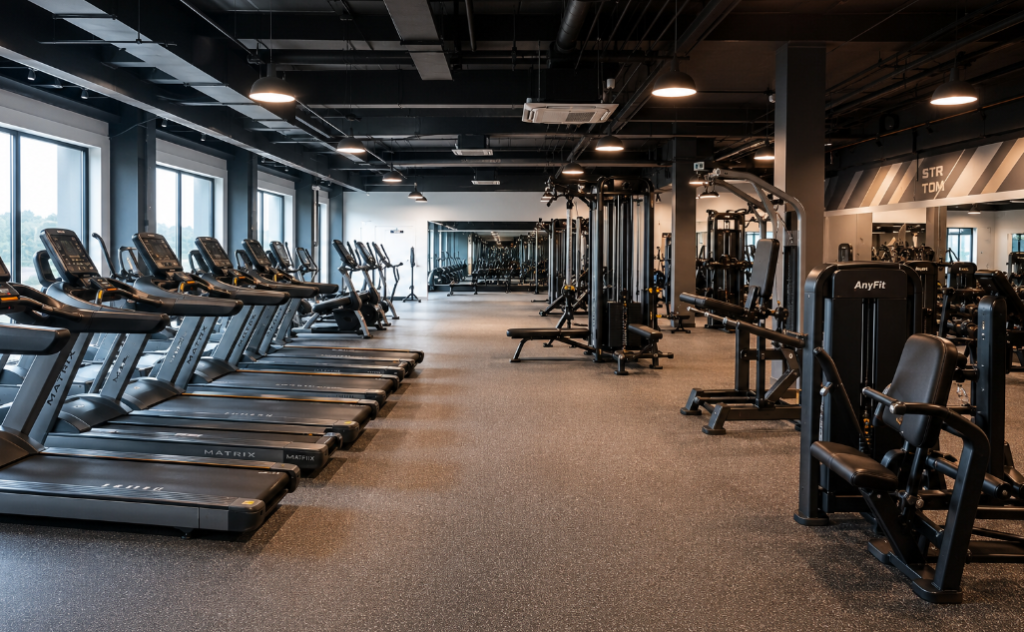
The demand side, at least, is working in your favor. According to the Health & Fitness Association (formerly IHRSA), US gym membership hit a record 77 million people in 2024, and growth has continued across most global markets. People are coming back to physical facilities. The question is whether your budget survives long enough to serve them.
The short answer: cost to open a gym by facility type
The single biggest mistake in gym startup budgeting is asking “how much does it cost to open a gym” without first deciding what kind of gym. The answer for a 1,200-square-foot personal training studio and a 15,000-square-foot full-service club are not even in the same universe. Here is the realistic landscape.
| Facility type | Typical size | Total cost to open | Equipment share |
|---|---|---|---|
| Personal training / small studio | 1,000–2,500 sq ft | $25,000–$100,000 | $15,000–$40,000 |
| Mid-size independent gym | 4,000–10,000 sq ft | $150,000–$500,000 | $40,000–$120,000 |
| Franchise location (24/7 model) | 3,500–7,000 sq ft | $400,000–$975,000 | Set by franchisor package |
| Large full-service club | 10,000+ sq ft | $500,000–$1,000,000+ | $120,000–$300,000+ |
Two notes on where these numbers come from, because sourcing matters. The equipment figures for the first two rows are drawn from our real export orders: PT studios buying from us typically invest $15,000–$40,000 in equipment, and mid-size independent gyms typically land between $40,000 and $120,000. The franchise row reflects published disclosure data; Franchise Times lists the total initial investment for Anytime Fitness, the world’s largest 24/7 fitness franchise, at $458,826–$907,607 with a $42,500 franchise fee. The large-club row is a broader industry estimate rather than our order-book data, and we flag it as such because our export volume is concentrated in the studio and mid-size segments.
If your project is a gym inside another business, such as a hotel fitness room or a corporate wellness center, the structure of the budget changes because rent often disappears; we cover those cases in dedicated hotel gym and corporate gym guides.
What goes into the cost to open a gym
Before drilling into each line, it helps to see the whole skeleton. Following the framework in the US Small Business Administration’s startup cost guide, the cleanest way to organize a gym budget is to separate one-time launch costs from the recurring monthly costs you must be able to cover before revenue catches up.
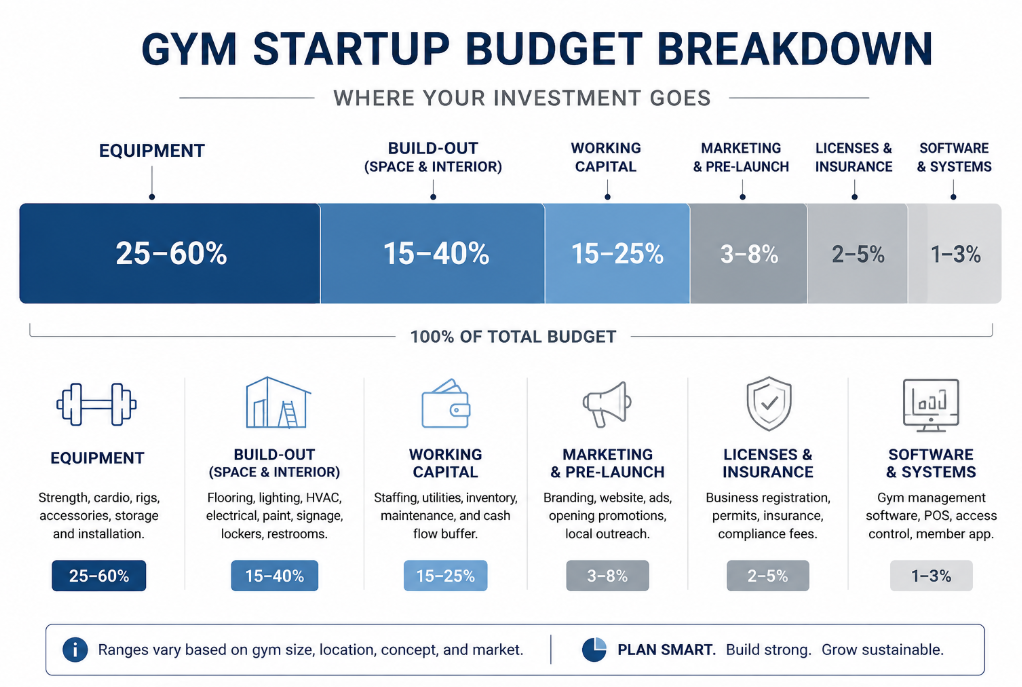
| Cost category | One-time or monthly | Typical share of launch budget |
|---|---|---|
| Equipment | One-time | 25–60% |
| Build-out and fit-out | One-time | 15–40% |
| Rent deposit and advance rent | One-time | 5–10% |
| Licenses, insurance, legal | One-time + annual | 2–5% |
| Software and technology | One-time + monthly | 1–3% |
| Pre-sale marketing | One-time | 3–8% |
| Working capital reserve | Covers monthly costs | 15–25% |
The two lines that decide your fate are equipment and build-out, because together they usually consume more than half the budget, and the working capital reserve, because running out of it is how otherwise healthy gyms die in month five. Let’s take them in order.
Equipment: the biggest controllable cost of opening a gym
Rent is set by your landlord. Wages are set by your labor market. Equipment is the one major line in the cost of opening a gym where your own decisions, about mix, grade, and sourcing, can move the total by a factor of two or more. That is why it deserves the most careful planning, and it happens to be the part we know from the inside.
How much gym equipment costs by facility type
From our order book, a working personal training studio needs surprisingly little to operate at a professional level: a rack or half rack, an adjustable bench or two, a full dumbbell run with racks, a barbell and plate set, one or two cardio pieces, a cable or functional trainer, and an accessories package. Bought factory-direct at commercial grade, that lands in the $15,000–$40,000 range depending on how deep the dumbbell run goes and how much cardio you add. We keep a full itemized version of this list in our personal training studio equipment guide.
A mid-size independent gym multiplies everything: a cardio row of six to fifteen machines, a selectorized strength circuit of ten to fifteen stations, a plate-loaded free-weight zone, multiple racks and benches, and a functional area. Our orders in this segment cluster between $40,000 and $120,000, with the spread driven mostly by how large the cardio row is, since motorized cardio is the most expensive category per unit, and whether the strength circuit is fully selectorized or leans on cheaper plate-loaded stations. A CrossFit-style box sits in between, light on machines and heavy on rigs, bars, and plates, and we break that mix out separately in our box equipment list.
One honest caveat on grade: every figure above assumes genuinely commercial-rated equipment. If a quote you receive is dramatically below these ranges, the first question to ask is whether the machines are actually built for commercial duty cycles, and we explain how to tell in our guide to what separates commercial from home equipment. Putting home-grade machines on a paying floor is the most expensive saving in this industry.
Factory-direct vs brand-name: how sourcing changes your gym startup cost
Here is the part of the budget where we have an obvious interest, so we will state it plainly and let the numbers speak. The same commercial-grade specification, comparable steel gauge, comparable load ratings, bought factory-direct from a Chinese manufacturer typically costs 40–60% less than the equivalent Western brand-name equipment, because you are not paying for the brand’s marketing, showroom network, and distribution margin. For a mid-size gym, that is routinely the difference between an $80,000 equipment budget and a $180,000 one.
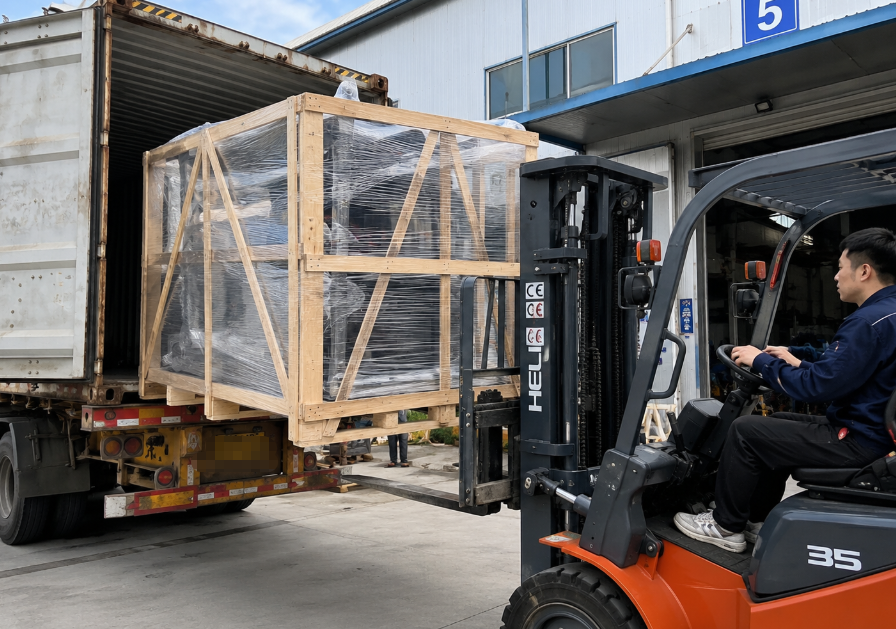
For a sense of scale from the franchise world, published disclosure documents for major fitness franchises typically show equipment packages of $130,000–$160,000 for a 3,500–7,000 square foot club at brand-name pricing, roughly double what a comparable factory-direct package costs. The trade-offs are real, longer lead times, more diligence required on your side, and shipping to arrange, and they are manageable if you go in with open eyes. We wrote a complete guide on how to buy commercial gym equipment from China that covers vetting, landed cost, and warranty terms.
New, used, or leased: three ways to lower the equipment cost of opening a gym
Beyond sourcing, there are two structural levers on the equipment line. Buying used commercial equipment can cut 30–60% off list prices, at the cost of unknown wear, expired warranties, and a dated floor; it works best for simple steel, racks, benches, and plates, and worst for motorized cardio, where the expensive components are the ones that wear. Leasing or financing converts the upfront cost into a monthly payment, which protects your working capital at the price of higher total cost over the term. Both deserve a full comparison, and we cover them properly in our new-versus-used breakdown and our lease-versus-buy analysis. The short version: a mixed strategy, new strength steel bought factory-direct, cardio either new-financed or carefully bought used, beats any single-channel approach for most independent openings.
Space and build-out: the least predictable gym startup cost
If equipment is the most controllable line, build-out is the least. Converting a raw or “vanilla shell” commercial space into a gym means flooring, HVAC upgrades sized for a room full of people producing heat, electrical work for cardio banks, plumbing for bathrooms and showers if you add them, lighting, and acoustic treatment. Across the projects our customers describe, this ranges from as little as $10–$20 per square foot for a space that was nearly gym-ready, to $50–$100+ per square foot for a full conversion with wet areas, and franchise disclosure documents show leasehold improvement lines running from under $100,000 to over $400,000 for the same brand depending on the site.
Because this line is so site-dependent, the highest-leverage negotiation in your entire startup is the lease itself. Tenant improvement allowances, where the landlord funds part of the build-out in exchange for lease length, are standard in commercial real estate, and every dollar of allowance is a dollar off your launch budget. Add the security deposit and one to three months of advance rent, and the space-related one-time costs for a mid-size gym typically total $60,000–$250,000. A PT studio in a smaller, gym-suitable room can hold this line under $30,000, which is precisely why the studio model is the affordable entry point into the industry.
How your country and city change the cost to open a gym
Most gym startup guides are written as if every reader lives in the United States, so a note for the rest of our readers in the UK, Europe, Australia, and beyond: the structure of the budget above holds everywhere, but three lines move sharply with geography, and it pays to know which ones before you borrow numbers from a US blog.
Rent and build-out move the most. The same 6,000 square feet costs radically different money in Manchester, Munich, Melbourne, and a US suburb, and labor rates for the trades doing your build-out follow the same pattern, so always price these two lines locally rather than converting someone else’s figures. Wages and mandatory employer costs come second; countries with higher statutory benefits and payroll taxes push the monthly operating base up even at identical headcounts, which flows straight into how much working capital you need. Equipment, by contrast, is the most geography-proof line in the whole budget, since factory-direct pricing is quoted in USD from the same production line wherever you are; what changes is the landing: ocean freight to your port, import duty under your country’s tariff schedule, and VAT or GST at your local rate, which most registered businesses later recover. As a planning rule, take the ex-factory equipment number, add freight, duty, and any non-recoverable tax for your destination, and you have a landed figure that is usually still far below local brand-name retail.
The practical takeaway: build your budget with local numbers for space and people, global numbers for equipment, and never assume a figure from another country’s guide transfers to yours without checking those three lines.
Licenses, insurance, and legal costs of opening a gym
This is the least exciting section of any gym budget and the one that varies most by jurisdiction, so treat these as planning ranges and verify locally. A business license and entity formation, health and safety permits where required, music licensing if you play it, legal review of your membership agreement and liability waiver, and general liability insurance together typically run $3,000–$10,000 to set up, with insurance recurring annually. Liability insurance premiums scale with square footage, member count, and whether you offer higher-risk programming, and gyms with staff add workers’ compensation on top. None of these numbers will sink a budget on its own; discovering a required permit after signing a lease can.
Staffing, software, and other monthly costs after opening a gym
The monthly cost base is what your working capital exists to cover, so build it honestly. A staffed mid-size gym carries wages as its largest recurring line, followed by rent, utilities, which run high for a gym because of HVAC load and hot water, insurance, software, and maintenance. Gym management software for memberships, billing, and access control typically costs $100–$300 per month, and 24/7 access-control hardware is a one-time addition of a few thousand dollars if you run a lean-staff model. As a planning anchor, most independent mid-size gyms we supply describe a monthly operating base of $8,000–$30,000 depending on market and staffing model, while a solo-operator PT studio can run under $5,000.
Equipment maintenance belongs in this list from day one, not as an afterthought. Budget roughly 3–5% of your equipment value per year for parts and upkeep, and stock a spare-parts kit at opening, especially for cardio, so a worn belt or console does not mean a machine sitting dead on the floor for six weeks.
Marketing and pre-sale: the gym startup cost that pays for itself
Marketing is the startup cost people cut first and regret first. The pattern among successful openings is consistent: a pre-sale campaign that starts 60–90 days before the doors open, built on founding-member pricing, local social advertising, and signage on the site itself, with a typical budget of $5,000–$20,000 depending on market size. The reason to protect this line is arithmetic, not sentiment. Opening with 150 pre-sold members instead of 20 changes your month-one revenue by five figures, which directly shortens the period your working capital must survive. A gym that opens quietly is spending its reserve to discover what a pre-sale would have told it for less.
Working capital: the cost to open a gym that most owners forget
Every list so far covers what it costs to open the doors. Working capital is what it costs to keep them open until revenue exceeds expenses, and leaving it out is the most common fatal error in gym startup budgets. The SBA’s guidance on startup costs is blunt about organizing for exactly this, and the industry-standard planning assumption is a reserve covering three to six months of full operating expenses. For a mid-size gym with a $15,000 monthly base, that is $45,000–$90,000 sitting in the bank on opening day, doing nothing but buying you time.
Membership revenue builds more slowly than optimistic spreadsheets assume, typically taking six to eighteen months for an independent gym to reach break-even, and the gyms that fail in that window are usually not the ones with the wrong equipment or the wrong location. They are the ones that spent their reserve on a nicer build-out.
Three example budgets: what it really costs to open a gym in 2026
Here is how the lines combine in three realistic scenarios, using factory-direct equipment pricing for the two independent formats. Treat these as templates to adapt, not quotes.
| Line item | PT studio (1,200 sq ft) | Mid-size gym (6,000 sq ft) | Franchise (per FDD) |
|---|---|---|---|
| Equipment | $22,000 | $75,000 | $130,000–$160,000 |
| Build-out & fit-out | $18,000 | $180,000 | $95,000–$430,000 |
| Deposit & advance rent | $6,000 | $25,000 | Included above |
| Licenses, insurance, legal | $4,000 | $8,000 | Included above |
| Software & technology | $2,000 | $6,000 | $30,000–$36,000 |
| Pre-sale marketing | $4,000 | $12,000 | $11,000–$23,000 |
| Franchise fee | — | — | $42,500 |
| Working capital (3–4 months) | $15,000 | $55,000 | Included above |
| Total | $71,000 | $361,000 | $459,000–$908,000 |
The franchise column, built from published Anytime Fitness disclosure figures, is worth a long look even if you never intend to franchise, because it is a professionally audited answer to what a complete, no-corners-cut opening costs at brand-name pricing. The gap between it and the independent mid-size column is mostly three things: the franchise fee, brand-priced equipment, and a more standardized build-out. That gap is the price of a proven system, and whether it is worth paying is a business-model question, not a budgeting one.
Try our gym startup cost calculator
Ranges are useful; your number is better. The interactive calculator below lets you build your own equipment list piece by piece, using editable factory-direct unit prices, toggle between factory-direct and brand-name pricing to see the sourcing gap on your actual list, and add rough figures for build-out, launch costs, and working capital to produce a complete opening estimate. Every price field is editable, so if you have real local quotes, drop them in and the totals update instantly. It is an estimating tool, not a quote, but it will get your budget conversation onto real numbers in about three minutes.
How to reduce the cost to open a gym without cutting quality
Pulling the levers together, the savings that do not come back to bite you are these. Source your strength equipment factory-direct at verified commercial grade, which is the largest single saving available and the core of our guide to buying commercial gym equipment from China. Negotiate the lease harder than the equipment, because a tenant improvement allowance and two months of free rent are worth more than any discount a supplier can give you. Phase the equipment plan, opening with a complete core floor and adding the second wave of machines from month-six revenue, rather than buying for the gym you hope to be in year three. Run a real pre-sale so revenue starts before rent does. And protect the working capital reserve as if the budget depended on it, because it does.
The savings to refuse are the mirror image: home-grade equipment on a commercial floor, skipping insurance or waiver review, and opening with an empty marketing line. Each one converts a visible saving today into a larger invisible cost within the first year.
If you are budgeting an opening right now, send us your floor plan or a rough equipment wish list and the destination country, and we will return an itemized factory-direct quote with commercial class ratings, warranty terms, and shipping estimate included, so the biggest controllable line in your budget becomes the most predictable one.
References
Franchise Times — Top 400 (2025): Anytime Fitness, initial investment range and franchise fee. https://www.franchisetimes.com/top-400-2025/44-anytime-fitness/article_32b06d07-029e-4d1c-895d-7987a8ab3f3e.html
U.S. Small Business Administration — Calculate your startup costs. https://www.sba.gov/business-guide/plan-your-business/calculate-your-startup-costs
Health & Fitness Association (formerly IHRSA) — industry and consumer research. https://www.healthandfitness.org/
