
Shipping Gym Equipment From China: Freight, Containers, and What It Really Costs
Shipping Gym Equipment From China: Freight, Containers, and What It Really Costs

Here is the number that should frame every conversation about shipping gym equipment from China: in February 2026, Drewry’s World Container Index — the independent benchmark most procurement teams reference — sat at about $1,919 per 40-foot container. By mid-August the same composite index had reached $4,339, with Shanghai to Los Angeles specifically at $6,244. Same route, same box, same year, more than double the price.
That volatility is the single most important thing to understand about freight, and it is why this guide will not give you a freight rate. Any number we printed would be wrong within weeks. What we can give you is the structure: how the shipping process actually works, what determines your cost, where gym equipment behaves differently from ordinary cargo, and how to check live rates yourself so the figure in your budget is current rather than borrowed from a blog.
We are a factory in the Yangtze River Delta shipping commercial gym equipment out of Shanghai and Ningbo, mostly on FOB terms with buyer-appointed forwarders. That gives us a specific and slightly unusual vantage point: we handle the origin half of the journey thousands of times, and we watch the destination half go well or badly depending on decisions buyers made weeks earlier. This is written from that half of the process.
How shipping gym equipment from China actually works, step by step
The sequence rarely changes, and knowing it makes every conversation with a supplier or forwarder more productive.
Production finishes and the goods are packed and crated at the factory. You or your forwarder book space on a vessel, ideally two to four weeks ahead — earlier in peak season. The factory prepares export documentation and the goods clear Chinese export customs. The container is loaded, either at the factory or at a warehouse, then trucked to the port of loading. It sails. On arrival, it is discharged, cleared through your country’s customs with duty and tax paid, released, and finally trucked to your facility, where somebody has to get several tonnes of equipment off a truck and through a door — a step buyers plan for last and should plan for first.
The elapsed time is longer than the sailing time, always. Sailing is the visible middle; booking lead time at one end and customs clearance plus inland delivery at the other typically add one to three weeks combined. When you build a schedule, count the whole chain.
FCL vs LCL: the first decision in shipping gym equipment from China
Your first structural choice is whether you fill a container or share one, and for gym equipment the answer matters more than it does for most cargo.
FCL — full container load — means you book an entire container. It is loaded at origin, sealed, and not opened again until it reaches you. LCL — less than container load — means your goods are consolidated with other shippers’ cargo, which requires handling at a consolidation warehouse in China, again at a deconsolidation warehouse at destination, and sometimes at points in between.
The pricing logic differs: FCL is a flat rate per container, so the more you put in it the lower your effective cost per unit; LCL is charged per cubic metre or per tonne, whichever yields more revenue for the carrier. Somewhere around 12–15 CBM, FCL usually becomes cheaper than LCL for the same goods, though the crossover moves with market rates.
For gym equipment specifically, there is a second argument for FCL that has nothing to do with price. Every additional handling event is an opportunity for damage, and heavy steel equipment sharing a container with pallets that shift is exactly how machines arrive dented. Transit damage is the most common post-delivery problem in this industry, and LCL structurally increases the exposure. If you are close to a full container, the case for filling it is stronger for gym equipment than for almost any other category.
| FCL (full container) | LCL (shared) | |
|---|---|---|
| Pricing basis | Flat per container | Per CBM or tonne |
| Handling events | Loaded once, sealed, opened by you | Consolidation, deconsolidation, sometimes more |
| Damage exposure | Lower — you control loading | Higher — mixed cargo, repeated handling |
| Typical crossover | Cheaper above ~12–15 CBM | Suits smaller orders |
| Schedule | Direct, more predictable | Waits for consolidation |
Container types and how gym equipment loads
Three container types cover almost all gym equipment shipments: the 20-foot standard, the 40-foot standard, and the 40-foot high cube, which offers roughly a foot of extra internal height and is the default choice for this cargo because so much of it is tall.
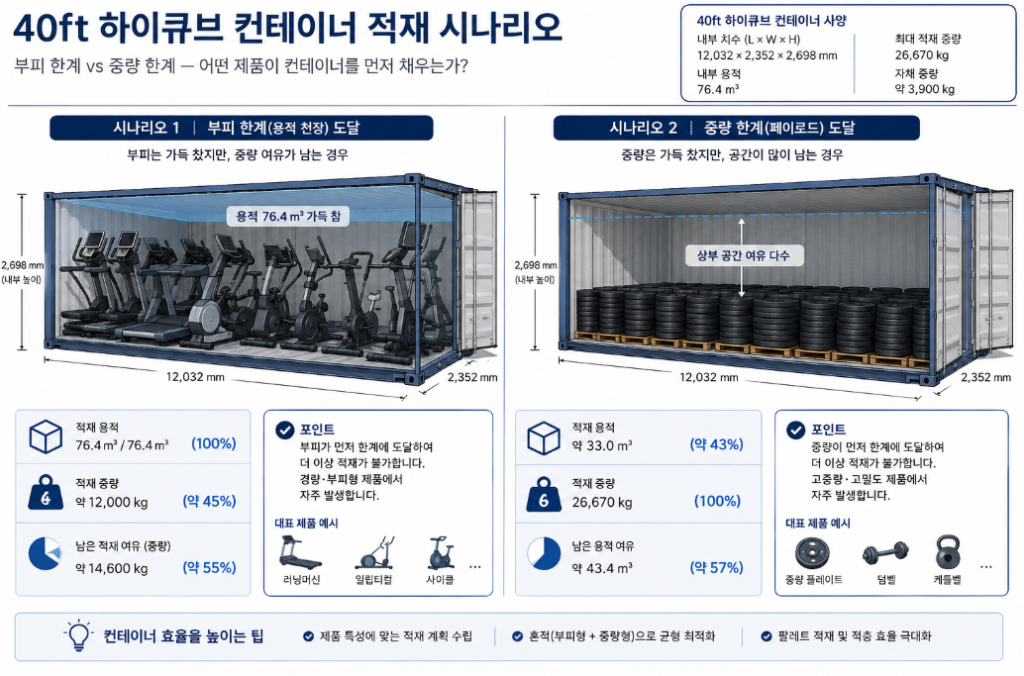
The peculiarity of gym equipment, which we covered from the MOQ angle in our minimum order guide, is that different products exhaust different limits. A container has both a volume ceiling and a weight ceiling, and they are independent. Cardio equipment is bulky and light, so a container of treadmills runs out of cubic metres with tonnes of unused payload. Weight plates and dumbbells are the reverse — the container hits its weight limit with visible empty space above the cargo. Frames, racks, and benches sit in between.
This creates a genuine cost-saving opportunity that buyers routinely miss: a mixed load ships more efficiently than a single-category load, because dense goods and bulky goods complete each other. If you are ordering both strength and cardio equipment, ordering them together in one container is materially cheaper than shipping them separately, and the factory can calculate the optimal combination if you send the list.
Two practices at our end also affect what fits. Much commercial equipment ships partially disassembled — uprights separated from bases, arms detached, seats removed — which can reduce shipping volume substantially, at the cost of assembly labour at your end. It is nearly always the right trade for ocean freight; ask what a machine’s shipping dimensions are assembled versus knocked down, because the difference sometimes decides whether your order fits one container or needs two. And weight distribution matters: heavy items like weight plates are laid flat across the container floor rather than stacked high, both for stability and because concentrated point loads damage whatever sits beneath them.
Export packing: protecting gym equipment in transit
Since transit damage is the most frequent claim in this trade, packing deserves specific attention, and it should be a written line item in your contract rather than an assumption. Our own standard for export orders is wooden crating on heavy and finish-sensitive items, corner protection, and load securing inside the container — but “standard packing” means different things at different factories, and a buyer who does not specify may receive cartons where crates were needed.
Four failure modes account for most damage: packing never upgraded for ocean transit, LCL consolidation pressure, rough handling at destination ports, and inadequate securing that lets heavy items shift through two weeks of swell. Gym equipment also has specific vulnerabilities — powder-coated tubes that grind through their finish when packed touching, chromed parts that need film against container dust, electronics that dislike the humidity a sealed steel box generates on a hot-weather route. We go through the full packing specification and the mistakes that cause damage in our sourcing mistakes guide; at the shipping stage, the essential move is simply to get the packing standard written into the order.
Two more protections belong here. Ask for loading photographs before the container seals — they document what was loaded and how it was secured, which is exactly the evidence an insurance claim requires. And buy marine cargo insurance regardless of your Incoterm, because transit damage is an insurance matter, not a warranty matter — a distinction that costs buyers real money when they discover it too late, and one we explain fully in our warranty guide.
What determines the cost of shipping gym equipment from China
Your total shipping cost is not one number from a forwarder; it is a stack, and knowing the components lets you spot what a quote is missing.
At origin: inland trucking from the factory to the port, export customs clearance, terminal handling, and documentation fees. On the water: ocean freight itself, plus fuel and currency adjustment surcharges, plus marine insurance. At destination: terminal handling again, customs clearance, import duty and VAT or GST, customs broker fees, any inspection charges, and inland delivery to your address.
Then two lines buyers consistently forget. Demurrage and detention are charges that begin when your container sits at the port beyond its free days, or when you keep the container too long after collection — they are avoidable with prompt clearance and expensive when they are not, and they are the most common unpleasant surprise on a first import. And unloading at your facility: several tonnes of equipment arrives on a truck, and unless you have a loading dock and a forklift, you need to arrange a liftgate truck or equipment to get it off. Confirm whether your delivery quote includes unloading. Frequently it does not.
Which of these you pay directly depends on your Incoterm — the ICC’s rules define exactly where the seller’s responsibility ends and yours begins, and we break down the FOB/CIF/DDP comparison in our main buying guide. The critical discipline, worth repeating because it is where quote comparisons go wrong: get every supplier and forwarder to quote on the same Incoterm to the same destination, or you are comparing numbers that cover different journeys.
| Cost layer | Typical items | Who usually pays under FOB |
|---|---|---|
| Origin | Inland trucking, export clearance, terminal handling, docs | Seller |
| Ocean | Freight, fuel/currency surcharges, insurance | Buyer |
| Destination port | Terminal handling, clearance, duty, VAT/GST, broker | Buyer |
| Delivery | Inland trucking, liftgate/unloading, demurrage if late | Buyer |
How to check current freight rates instead of guessing
Because rates move as violently as the February-to-August figures above demonstrate, the useful skill is knowing where to look rather than what to memorise.
Drewry’s World Container Index is published free every Thursday and covers eight major East–West lanes including Shanghai to Los Angeles, Shanghai to New York, Shanghai to Rotterdam and Shanghai to Genoa, quoted in dollars per 40-foot container. That makes it directly usable as a sanity check on a forwarder’s quote — not a price you can book, since it is a spot benchmark rather than an offer, but a reference that tells you whether a quote is in the right neighbourhood. The Shanghai Containerized Freight Index serves a similar purpose from the China side. Digital freight platforms also publish live indicative rates on major lanes.
Use these to calibrate, then get two or three real quotes for your specific shipment. And when you get them, ask what is excluded, because the gap between a headline ocean rate and a landed cost is where most budget surprises live.
Choosing a freight forwarder for gym equipment shipments
Most of our orders ship FOB with a forwarder the buyer appointed, and some ship with a forwarder we introduced. Both work; the failure mode is having no forwarder relationship at all and improvising at the last minute.
A buyer-appointed forwarder in your own country is usually the better choice for anyone importing regularly. They are contactable in your time zone, accountable to you rather than to the supplier, able to advise on your country’s customs requirements, and they can consolidate shipments from multiple suppliers if you buy from more than one. A supplier-recommended forwarder can be genuinely useful for a first-time buyer — they know the origin process and the factory — but understand the relationship: the forwarder’s commercial tie is to the party who brings them repeat business.
When you select a forwarder, ask whether they handle your specific lane regularly, whether they can quote door-to-door or only port-to-port, what their customs brokerage arrangement is at destination, what insurance they offer, and — the question that separates good from adequate — how they handle problems: a rolled booking, a customs hold, a damaged container. The answer tells you what you are actually buying, which is not transport but problem resolution.
For heavy equipment specifically, ask two more: do they have experience with oversized or heavy freight, and can they arrange delivery to a site without a loading dock. A forwarder who has moved gym equipment before will raise the unloading question themselves.
Documents and customs when importing gym equipment from China
The documentation set is standard and your forwarder will drive it, but you should know what each piece does, because errors here cause the delays that turn into demurrage.
The commercial invoice and packing list describe what is being shipped, its value, and how it is packed. The bill of lading is the contract of carriage and the document that controls release of the goods — which is why payment terms are often structured against a copy of it. The certificate of origin may be needed for preferential duty treatment. And your goods need a correct HS classification, which determines your duty rate; fitness equipment generally falls under heading 9506, and getting the classification right matters both for cost and for compliance, as we cover in the landed-cost section of our buying guide.
Two practical notes from the origin side. Ensure the description on the documents matches the goods precisely and consistently across every document — mismatches are a common trigger for customs holds. And confirm early whether your destination market requires conformity documentation for the equipment itself, such as CE marking for the European market, because that is a product question with a shipping deadline attached.
What goes wrong at the destination, and how to limit the damage
The origin half of the journey is the half a factory controls, and it is generally the predictable half. Most of the unpleasant surprises in an import happen after the vessel arrives, so it is worth knowing the common ones in advance.
Rolled bookings. Carriers overbook, and when a vessel fills, some containers get bumped to the next sailing — which on a weekly service means a week’s delay before your cargo has moved at all. It happens most in peak season and around blank sailings, the cancelled departures carriers use to manage capacity. The mitigations are booking earlier, avoiding the tightest windows, and asking your forwarder whether your rate is a guaranteed-space product or a spot booking that can be rolled.
Customs holds and examinations. A percentage of containers are selected for inspection, sometimes at random, sometimes because documentation is inconsistent or a classification looks wrong. An examination costs days and fees. The controllable part is documentation: consistent descriptions, correct HS classification, and accurate values across every document remove the avoidable triggers.
Free time running out. This is the one that quietly costs the most. Containers come with a limited number of free days at the terminal before demurrage begins, and a separate allowance before detention starts on the equipment itself. A buyer who is slow to clear customs, or who has nowhere to put several tonnes of equipment on the day it arrives, starts paying daily charges on a clock they did not know was running. Ask how many free days your booking includes, have paperwork ready before the vessel arrives, and know where the equipment is going the day it lands.
The general principle: at destination, speed is money, and everything that can be prepared before arrival should be.
Consolidating gym equipment shipments from multiple suppliers
Buyers equipping a full facility often buy from more than one source — machines from one factory, flooring from another, accessories from a third — and how you combine those shipments has a real effect on cost.
The mechanism is consolidation: a freight forwarder with a warehouse in China receives goods from each of your suppliers, holds them until everything arrives, and loads one container. You pay for warehousing and handling, and you gain a single FCL shipment instead of several LCL ones, which is usually cheaper and always involves fewer handling events. For a buyer sourcing from two or three Chinese suppliers, this is frequently the difference between a sensible freight bill and an absurd one.
Two practical requirements. First, the suppliers must finish at roughly the same time, so coordinate production schedules — a consolidation waiting three weeks for one late supplier costs storage and delays everything. Second, someone must check what arrives at the warehouse against what was ordered, because a consolidation warehouse receives sealed cartons and has no idea whether the contents match your purchase order. That is precisely what a pre-shipment inspection is for, and consolidating without one means your first look at the goods is at your own door.
This also connects to the container-filling logic above: if your equipment order alone does not fill a container, consolidating other purchases into the same box is often the cheapest way to reach FCL economics rather than paying LCL rates on everything.
Planning your shipping timeline
Work backwards from the date you need equipment on your floor, and build in the pieces buyers forget.
Production time comes first and varies with order size and customisation. Then booking lead time, typically one to three weeks depending on season and lane. Then the sailing itself. Then customs clearance and inland delivery, usually several days to a couple of weeks. Then — and this is the step most often omitted — assembly and installation time before the equipment is actually usable.
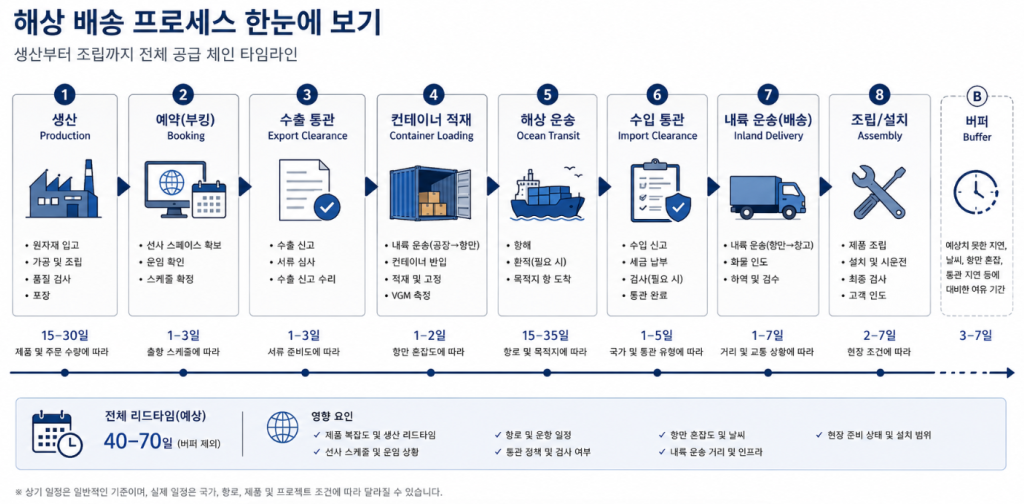
Two seasonal factors dominate this calendar. Chinese New Year stops production and compresses shipping on both sides of the holiday, and the effects run from January into March; anything landing in that window needs a substantial buffer, for reasons we detail in our sourcing mistakes guide. Peak shipping season in the second half of the year tightens vessel space and pushes rates up, which is also when blank sailings — cancelled departures used by carriers to manage capacity — make bookings less reliable. Book earlier than feels necessary in both windows.
The practical rule: whatever the sum of your steps, add a buffer. A gym that opens two weeks late because a container was rolled is an expensive lesson in a cheap precaution.
The short version
Shipping gym equipment from China is not complicated, but it rewards specificity. Fill a container if you can, because it is cheaper and safer for heavy steel. Mix dense and bulky products in the same load to use both ceilings. Specify the packing in writing and get loading photographs. Insure the cargo. Quote everything on one Incoterm. Check a live rate index instead of trusting a number from an article. Appoint a forwarder before you need one, and ask them how they handle problems. Plan the whole chain, not just the sailing, and add a buffer.
If you are working out what your equipment list means in container terms, send it to us with your destination port and we will tell you what it occupies assembled and knocked down, which container it fits, and where the volume and weight ceilings land — the calculation takes us minutes and it is usually the number buyers most need before they can budget anything else.
References
International Chamber of Commerce — Incoterms® 2020 Rules. https://iccwbo.org/business-solutions/incoterms-rules/incoterms-2020/
Drewry — World Container Index, weekly independent container freight rate benchmark. https://www.drewry.co.uk/supply-chain-advisors/supply-chain-expertise/world-container-index-assessed-by-drewry
Maersk — Cargo weight limits and container capacities. https://www.maersk.com/support/faqs/cargo-weight-limit
