
How to Buy Commercial Gym Equipment From China: A Buyer’s Guide From the Factory Floor
How to Buy Commercial Gym Equipment From China: A Buyer’s Guide From the Factory Floor

Most guides on how to buy commercial gym equipment from China are written by people who have never stood on a factory floor. This one is different. We manufacture and export commercial fitness equipment, and every day we sit on the other side of the table from the buyers this article is written for: gym chains rolling out a consistent fit-out across sites, distributors stocking containers for resale, and independent gym and PT studio owners trying to make a fixed budget go as far as it can.
That vantage point means we see exactly where deals go well and where buyers get burned. So this is not a sales pitch. It is an honest look at why sourcing from China works, where the real risks are, and the specific things to lock down before you wire a deposit. If you read to the end, you will understand the trade-offs, the three mistakes that cost buyers the most money, and a step-by-step process you can actually follow.
Why buyers choose to source commercial gym equipment from China
China became the default sourcing base for commercial fitness equipment for reasons that have nothing to do with hype. The country has a deep, mature supply chain for steel fabrication, upholstery, powder coating, electronics, and assembly, often clustered in the same industrial regions. That density is what lets a single factory quote a full gym fit-out, from power racks to treadmills, at prices that established Western brands cannot match on a like-for-like basis.
But “cheaper” and “better value” are not the same thing, and pretending otherwise is how buyers end up disappointed. Below is the honest picture of both sides.
The real advantages of buying commercial gym equipment from China
The pricing gap is genuine. For the same steel gauge, weld quality, and hardware, a Chinese factory typically lands 30–60% below a comparable branded product, because you are paying for the equipment rather than a brand premium and a Western distribution margin. For a distributor or a multi-site operator, that gap is the whole business case.
Beyond price, the advantages that matter most in our export orders are manufacturing capacity and range. A serious factory can build a container of mixed strength and cardio equipment on one production run, and it can offer OEM and ODM work, meaning it will build to your drawings or restyle an existing platform in your colors with your logo. That one-stop breadth is why a single supplier can equip an entire facility instead of forcing you to coordinate five vendors.
The honest risks of buying commercial gym equipment from China
The flip side is real and worth stating plainly. Quality varies enormously between suppliers. Two factories in the same city can ship products that look identical in photos but differ in frame thickness, weld penetration, bearing quality, and upholstery durability, and those differences only show up after months of commercial use. Distance adds lead time and makes problems slower to fix. Communication gaps cause spec misunderstandings. And after-sales support is genuinely harder across an ocean than it is with a local dealer down the road.
None of these risks is a reason not to source from China. They are reasons to source carefully. The rest of this guide is about doing exactly that.
| What you gain | What you trade off |
|---|---|
| 30–60% lower unit cost for equivalent build | Wide quality variance between suppliers |
| Factory capacity for full, mixed fit-outs | Longer lead times and slower issue resolution |
| OEM/ODM customization and branding | Communication and spec-clarity risk |
| One supplier for an entire facility | After-sales support is harder across distance |
Who actually buys commercial gym equipment from China
We ship to three broad buyer types, and the smartest thing you can do before you start is be honest about which one you are, because your priorities and your negotiation checklist change accordingly.
Gym chains and franchise brands care most about consistency and brand fit. They are buying the same machines for multiple locations, often over several years, so the specification, the finish, and the reliability of restocking matter more than shaving the last few dollars off a unit price. For this buyer, an OEM specification sheet and a written spare-parts commitment are worth more than a small discount.
Distributors and wholesalers are running a margin business. They need a competitive landed cost, a range broad enough to serve their own customers, and a supplier who can restock reliably without long gaps. Pricing tiers, dependable lead times, and spare-parts stock held at the factory are the levers that make or break their model.
Independent gym owners and PT studio operators are usually working against a fixed budget for a single facility. Their challenge is getting the right mix of equipment at the right durability without over-ordering, and the landed cost, the commercial-grade rating, and installation support carry the most weight.
| Buyer type | Main priority | Typical order | What to lock down first |
|---|---|---|---|
| Gym chain / franchise | Consistency across sites | Multi-site, repeat orders | OEM spec sheet, warranty, spare-parts commitment |
| Distributor / wholesaler | Margin and reliable restock | Full containers, mixed SKUs | Price tiers, lead time, factory spare-parts stock |
| Independent gym / PT studio | Budget vs durability | One container or LCL | Landed cost, class rating, install support |
How order size and MOQ shape what you can buy from China
Before you approach suppliers, it helps to understand how your order size changes what is realistically available to you, because it is one of the biggest differences between sourcing from China and buying from a local dealer. Chinese factories are built around production runs, so most set a minimum order quantity, and that MOQ is the lever that decides your price, your customization options, and sometimes whether a factory will engage with you at all.
For a distributor ordering full containers, MOQ is rarely a constraint, and volume unlocks the best pricing tiers and full OEM freedom. For a multi-site gym chain, the repeat nature of the business gives similar leverage even when each individual order is moderate. The buyer who feels MOQ most is the independent operator equipping a single facility, who may need to consolidate a mixed order to reach a workable minimum, accept a standard catalog product rather than a fully customized one, or share a container with other stock.
The practical takeaway is to know your realistic order volume before you ask for quotes, and to be upfront about it, because it lets a factory tell you honestly whether standard, semi-customized, or full OEM production fits your scale. We cover minimum order quantities and the OEM-versus-ODM decision in dedicated guides, but at the planning stage, matching your ambitions to your volume saves everyone time and avoids quotes built on assumptions that fall apart later.
Mistake #1 — Judging commercial gym equipment from China on unit price alone
This is the single most expensive mistake we watch buyers make, and it is worth understanding why. When you compare two quotes side by side, the number that jumps out is the unit price. But that number tells you almost nothing about what actually determines whether a machine survives years of commercial punishment.
The difference between a cheap machine and a durable one lives in places a spreadsheet never shows: the gauge of the steel in the frame, whether the welds have full penetration or are cosmetic surface beads, the quality of the bearings and bushings in the moving parts, the density and stitching of the upholstery, and the coating that either resists sweat and chips or starts flaking within a season. Two products can look the same in a listing photo and differ by years of useful life.
We see the consequence of price-only buying in our own after-sales records. When a frame is under-built, it does not just wear faster; it arrives more fragile and is more prone to transit damage, and it fails earlier under the constant loading of a commercial floor. A machine that was 20% cheaper but lasts half as long is not a saving. It is a more expensive machine paid for in installments of downtime and replacement.
What “commercial grade” actually means, and how to spec it
“Commercial grade” is a phrase every supplier will use and few will define. The most useful way to hold a supplier to it is to reference the international safety standard for stationary training equipment, ISO 20957. That standard classifies equipment into use classes, and the distinction that matters to you is Class S, for professional and commercial or studio use, versus Class H, for domestic home use. A machine rated only for home use does not belong on a paying gym floor, no matter how it is marketed.
When you write your specification, ask the supplier to confirm the intended class, the maximum rated load, the frame steel gauge, and the coating type in writing, and ask whether they can provide test reports. A factory that builds genuine commercial equipment will answer these questions comfortably. A supplier that gets vague is telling you something important. We go deeper on the full commercial-versus-home distinction in a separate guide, but for sourcing purposes, the class rating is the fastest filter you have.
Mistake #2 — Underestimating the landed cost of gym equipment from China
The second costly mistake is treating the factory quote as the price. It is not. The price you actually pay to get commercial gym equipment from China onto your floor includes several layers that first-time buyers routinely underestimate, and the gap between the quoted unit price and the real landed cost can easily reach 20–40%.
The layers are freight, insurance, destination port charges, customs duty, import taxes such as VAT or GST, a customs broker, and final delivery. On top of that sit two things buyers forget entirely: the cost of any rework or replacement if quality slips, and the spare parts you should be stocking from day one. Add them up before you commit, not after the container lands.
Getting quotes you can actually compare
Here is a trap we watch buyers fall into constantly. They request quotes from three suppliers, and one quotes ex-works their factory, another quotes FOB the port of loading, and a third quotes CIF or DDP to destination. These are not the same price, and comparing them directly is meaningless, because each term includes a completely different slice of the shipping journey.
Those three-letter terms are Incoterms, the internationally recognized trade rules published by the International Chamber of Commerce. Under FOB, the seller gets the goods loaded onto the vessel and the buyer takes over cost and risk from there. Under CIF, the seller also pays freight and minimum insurance to the destination port. Under DDP, the seller handles almost everything, including import duty, and delivers to your door. The simplest way to get comparable quotes is to tell every supplier the exact Incoterm and destination you want them to quote on. When the terms match, the numbers finally mean something. We cover freight, container loading, and shipping logistics in depth in a dedicated guide, but this one habit alone prevents most quote confusion.
Duties, taxes, and the HS code for gym equipment
Import duty is the layer buyers most often forget, and it is entirely predictable if you look it up in advance. Commercial fitness equipment generally falls under Harmonized System heading 9506, and more specifically subheading 9506.91.00, which covers articles and equipment for general physical exercise, gymnastics, or athletics. Under the US Harmonized Tariff Schedule, the base most-favored-nation duty rate for 9506.91.00 is 4.6%.
Two honest caveats. First, that 4.6% is the United States base rate; your duty depends on your own country’s tariff schedule, and rates differ widely between markets. Second, some countries apply additional tariffs or trade measures on Chinese-origin goods on top of the base rate, and those change over time, so confirm the current total for your destination with your customs broker before you build your budget. The point is not the exact figure. It is that duty is knowable in advance, and the buyers who get surprised are the ones who never checked.
| Cost component | Who typically pays under FOB | Notes |
|---|---|---|
| Ex-works equipment price | Seller quotes it | The number most buyers mistake for the total |
| Export packing and crating | Seller | Under-crating causes transit damage — see below |
| Inland transport to port | Seller | Included in FOB |
| Ocean freight | Buyer | Varies with container type and route |
| Marine cargo insurance | Buyer (unless CIF) | Worth buying regardless |
| Destination port and handling | Buyer | Often underestimated |
| Import duty and VAT/GST | Buyer | Check your country’s HS 9506 rate |
| Customs broker and delivery | Buyer | Budget for it upfront |
Mistake #3 — Vague warranty and spare-parts terms on gym equipment from China
The third mistake is signing a deal where the warranty and spare-parts arrangements are a friendly verbal understanding rather than written terms. This is where distance bites hardest, and our own after-sales experience shows exactly why it matters.
The most common post-purchase problems we deal with are not dramatic failures. They are missing or wrong parts in a shipment, and long wait times when a customer needs a replacement part months later. Both are manageable, but only if you have addressed them before shipping. If you wait until a part is missing or broken to discover that spare-parts lead time is six weeks and the freight is on your account, you have a piece of equipment sitting idle and a bill you did not plan for.
Pin down the specifics in writing before you order. Get the warranty duration and scope for each major component, not a blanket phrase. Confirm which wear parts, such as cables, pulleys, belts, and upholstery, are available as spares and what the lead time is to restock them. Agree who pays freight on warranty replacements. And for anything you are ordering in volume, negotiate a spare-parts kit shipped with the original order so that the common wear items are already on your shelf. That single step turns your most likely after-sales headache into a non-event. We treat warranty and after-sales in more detail elsewhere, but the principle is simple: what is not written down does not exist once the container has left the port.
How to vet a commercial gym equipment supplier in China
Everything above assumes you are dealing with a capable factory. Choosing the right supplier is the decision that determines whether the rest goes smoothly, so it deserves real diligence.
The first distinction to establish is whether you are talking to a genuine manufacturer or a trading company. Neither is automatically wrong, but you should know which one you have, because it changes your pricing, your ability to customize, and your after-sales path. A real factory can show you its business license with a manufacturing scope, walk you through the production line on a video call, quote transparently, and support you directly on technical questions. A trading company adds a margin and a layer between you and the people who actually build the product.
Then verify capability rather than taking it on trust. Ask for certifications and test reports, including ISO 20957 conformity for the equipment and ISO 9001 for the quality management system, plus CE marking if you are importing into Europe. Arrange a factory audit, either in person or through a live video walkthrough or a third-party inspection service. And order a sample of your key machine before committing to a full order, so you are judging the actual build quality rather than photographs. We have a dedicated guide on how to find and vet a gym equipment manufacturer in China that goes step by step through the audit process.
| Signal | Genuine factory | Trading company |
|---|---|---|
| Business license scope | Manufacturing | Trade / wholesale |
| Customization ability | Builds to your drawings | Limited, relays requests |
| Factory audit | Live line walkthrough | Cannot show production |
| Technical answers | Direct from engineers | Slower, second-hand |
| Pricing | Transparent, factory-direct | Includes an added margin |
Protecting quality and delivery when importing gym equipment from China
Even with a good factory, two things go wrong often enough that you should plan for them: transit damage and shipment discrepancies. Our most frequent real after-sales issue is not a manufacturing defect at all; it is equipment that arrives with dents or damage from the journey. The ocean freight environment is rough, and inadequate packing is the usual culprit.
The defenses are straightforward. Insist on proper export crating for heavy and finish-sensitive items rather than thin cartons, and make it part of the written agreement. Buy marine cargo insurance regardless of your Incoterm, because it is cheap relative to the value at risk. Use a pre-shipment inspection, either your own agent or a third party, to check the goods and the packing list against your order before the container is sealed, which is the single most effective way to catch missing or wrong parts while they can still be fixed. And plan your spare-parts stock in advance, as discussed above, so a damaged component does not mean weeks of downtime.
One smaller point worth a mention: confirm the electrical specification on any powered equipment, such as treadmills, matches your market’s voltage and plug standard. This is rarely a problem when it is specified upfront, and occasionally an expensive one when it is assumed.
A step-by-step process to buy commercial gym equipment from China
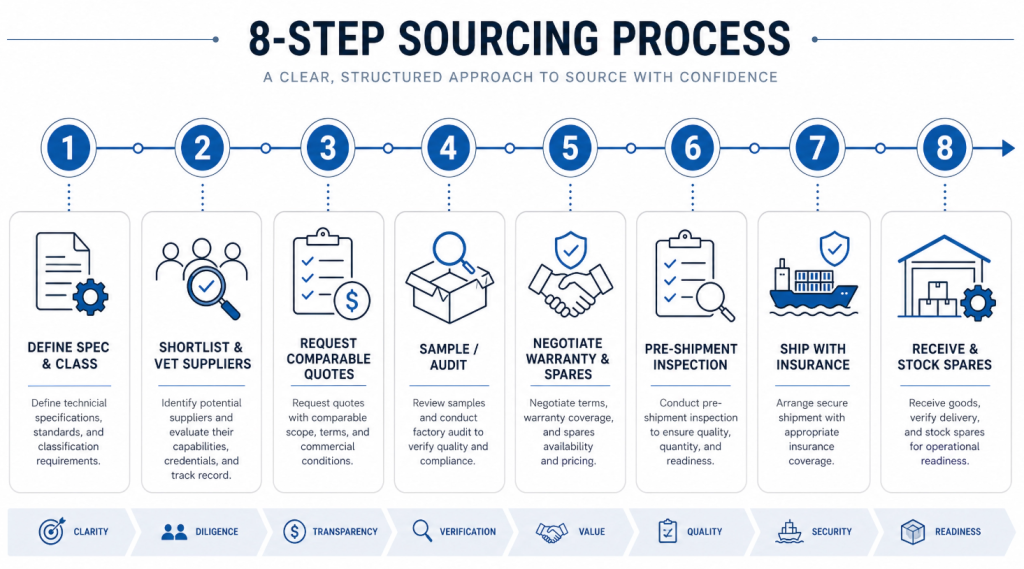
Pulling it all together, here is the process we would recommend to any buyer, in order.
First, define your specification, including the equipment mix, the ISO 20957 class you require, the frame and coating specs, and any branding for OEM work. Second, shortlist suppliers and vet them, separating genuine factories from traders and checking certifications. Third, request quotes from your shortlist on identical Incoterms and destination so the numbers are comparable. Fourth, order a sample or arrange a factory audit before committing to volume. Fifth, negotiate and put in writing the warranty scope, spare-parts availability and lead time, and payment terms. Sixth, arrange a pre-shipment inspection against your order and packing list. Seventh, ship under an agreed Incoterm with marine insurance in place. Finally, receive and install the equipment, and keep your spare-parts kit stocked from day one.
Follow that sequence and you have converted the real risks of sourcing from China, quality variance, hidden landed cost, and weak after-sales, into a controlled, predictable purchase.
We build commercial fitness equipment for exactly the buyers this guide is written for, and we would rather work with a customer who has read something like this and knows what to ask than sell to someone who will be surprised later. If you are planning a fit-out or building a range to distribute, send us your equipment list and destination and we will put together a clear, itemized quote, with the class ratings, warranty, and spare-parts terms spelled out from the start.
References
United States International Trade Commission — Harmonized Tariff Schedule, heading 9506 (subheading 9506.91.00). https://hts.usitc.gov/
International Organization for Standardization — ISO 20957-1:2024, Stationary training equipment — Part 1: General safety requirements and test methods. https://www.iso.org/standard/81908.html
International Chamber of Commerce — Incoterms® 2020 Rules. https://iccwbo.org/business-solutions/incoterms-rules/incoterms-2020/
