
How to Find and Vet a Gym Equipment Manufacturer in China (From the Factory Side)
How to Find and Vet a Gym Equipment Manufacturer in China (From the Factory Side)

There are three channels where serious buyers actually find gym equipment manufacturers in China — Alibaba, the big trade shows, and plain search-engine research — and four things the smartest of those buyers audit before ordering: the production line and welding shop, the QC process and testing equipment, the certificates, and the export track record. We know, because we are the ones being audited. We manufacture commercial gym equipment in China’s Yangtze River Delta, and buyers from every continent have walked our floor, pointed cameras at our weld seams on video calls, and asked us to produce certificate originals on the spot. This guide is the view from our side of that inspection: what the buyers who end up happiest actually check, and where the ones who get burned went wrong.
One scope note before we start. This article is a companion to our main guide on how to buy commercial gym equipment from China, which covers the purchasing process itself — specifications, comparable quotes, landed cost, and warranty terms. This piece covers the step before all of that: finding the right factory and proving it is what it claims to be. Get this step right and the rest of the process gets dramatically easier.
Where gym equipment manufacturers in China are located
China’s fitness equipment industry is not spread evenly across the country. It is concentrated in a handful of industrial clusters, and knowing the map is genuinely useful when you are qualifying suppliers, because a factory’s location tells you something about its supply chain, its labor pool, and its typical product focus.
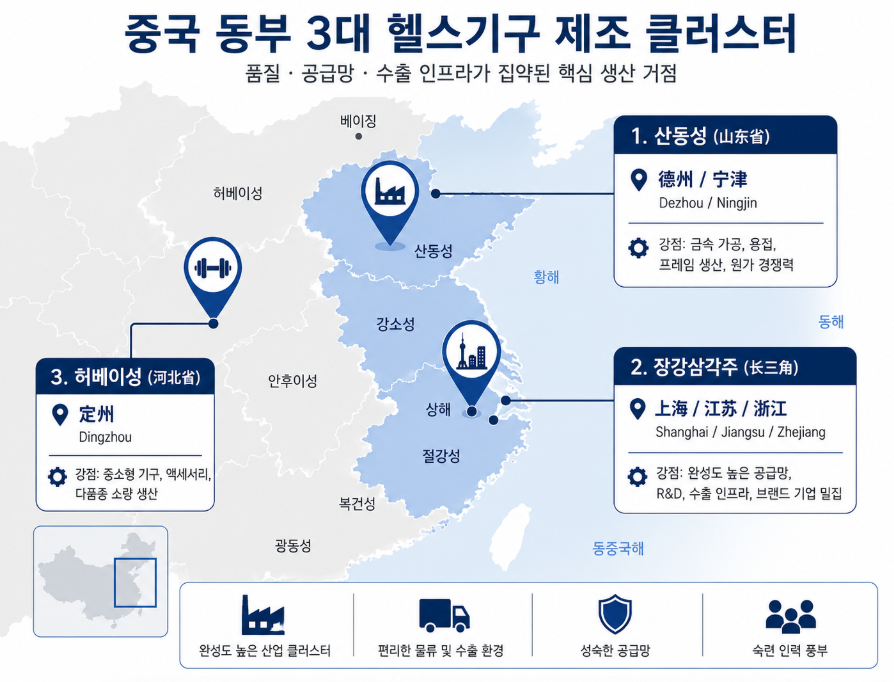
The largest single cluster for commercial fitness equipment is in Shandong province, centered on Dezhou and especially Ningjin county, an area so dense with fitness manufacturers that it markets itself as the hometown of China’s fitness equipment industry. Hundreds of factories and their component suppliers sit within a short drive of each other, covering everything from budget home machines to full commercial lines. The Yangtze River Delta — Shanghai and the surrounding Jiangsu and Zhejiang provinces, where our own factory is located — is the second major base, generally more export-oriented, with strong access to electronics and motor suppliers for cardio equipment and to the Port of Shanghai. Hebei province, particularly around Dingzhou, is a third cluster known mostly for entry-level and outdoor fitness products at aggressive prices.
| Cluster | Center | Typical strengths | Watch for |
|---|---|---|---|
| Shandong | Dezhou / Ningjin | Deepest commercial-equipment supply chain, huge factory density | Quality varies widely within the cluster |
| Yangtze River Delta | Shanghai / Jiangsu / Zhejiang | Export orientation, cardio & electronics supply chain, port access | Generally higher cost base than inland |
| Hebei | Dingzhou area | Budget and outdoor equipment, low prices | Confirm commercial-grade rating carefully |
Two honest caveats on this map. First, a cluster address is context, not a quality guarantee; every cluster contains excellent factories and terrible ones, including ours. Second, do not treat cluster stereotypes as disqualifiers — a Shandong factory can beat a Delta factory on a given product line and vice versa. The map tells you what questions to ask, not what answers you will get.
Where to find gym equipment manufacturers in China
Buyers reach us through three channels, and their share of our real inquiries has been stable for years: Alibaba, trade shows, and search engines leading to our website. Each channel has a distinct signal-to-noise profile, and using them together works better than relying on any single one.
Finding gym equipment manufacturers on Alibaba
Alibaba International is where most first-time buyers start, and for good reason: nearly every gym equipment manufacturer in China maintains a presence there, so it is the fastest way to build a longlist. Use the filters intelligently — supplier age, verified-supplier status, response rate, and transaction history all carry some signal — but understand the platform’s two structural weaknesses. Rankings are heavily influenced by advertising spend, so prominence does not equal capability, and trading companies are abundant and often indistinguishable from factories at listing level. Treat Alibaba as a discovery tool that produces candidates for vetting, never as the vetting itself.
Meeting Chinese gym equipment manufacturers at trade shows
Fitness trade shows compress months of supplier research into a few days. In China, the key event is IWF Shanghai, held every March, which has a dedicated foreign OEM/ODM trade section; the China Sport Show (the domestic sporting goods expo) is the other major fixture, and internationally, many Chinese manufacturers exhibit at FIBO in Cologne. A booth visit lets you inspect finish quality and weld seams in person, meet the actual sales engineers, and calibrate your sense of the market in a way no screen allows. The caveat: a polished booth proves marketing budget, not manufacturing capability, and some exhibitors are traders presenting factory goods as their own. Collect candidates at the show; verify them afterward with the audit process below.
Researching gym equipment manufacturers in China by website
The third channel is the one you are using right now: searching, reading, and judging manufacturers by their own websites. A factory’s site tells you more than it intends to. Look for production-floor photos where the machines, flooring, and branding are consistent across images rather than assembled from stock photography, a verifiable physical address that matches the business license, genuine technical depth in product specifications, and content written by people who clearly build the product. A site that is all lifestyle renders and superlatives, with no floor, no address, and no specs, is telling you something too.
| Channel | Best for | Main weakness |
|---|---|---|
| Alibaba | Building a longlist fast | Pay-influenced rankings, traders mixed in |
| Trade shows (IWF Shanghai, China Sport Show, FIBO) | Physical inspection, meeting teams | Booth quality ≠ factory quality |
| Search + manufacturer websites | Depth research, technical evaluation | Websites can be dressed up |
Manufacturer or trading company: the first test for any China gym equipment supplier
Before any deeper audit, settle the most basic question about a Chinese supplier: is this a factory or a trading company? We covered why the distinction matters in the main buying guide; here is how to actually check, because asking “are you a factory?” produces the same answer from everyone.
Start with the business license (营业执照). Every legitimate Chinese company has one, and it states the registered company name, the unified social credit code, the registered address, and — critically — the business scope. A manufacturer’s scope includes production or manufacturing terms (生产, 制造); a pure trader’s scope reads wholesale, trade, or import/export only. Ask for the license early; a real factory sends it without hesitation. Then cross-check: does the company name on the license match the name on the website, the quote, and later the certificates? Does the registered address match where they claim the factory is? Name and address mismatches are how traders borrowing a factory’s identity get caught.
The second test is a live video call with a walkthrough request. A manufacturer can take you to the production line on the spot, and the people on the call can answer technical questions — steel gauge, weld process, load testing — in real time without relaying them to someone else. A trader stalls, schedules, and relays. Neither response is proof on its own, but the pattern across license, walkthrough, and technical fluency is very hard to fake.
Questions to ask a gym equipment manufacturer in China before you audit
Auditing takes time, so it pays to shrink the longlist first with a short written screen. We answer versions of these questions every week, and from the factory side we can tell you: the pattern of the answers — their speed, their specificity, and above all their honesty — filters suppliers faster than the content does.
Ask which machines the factory makes in-house and which it buys in. This question is a trap for the dishonest and a green flag for the honest, because almost no gym equipment manufacturer in China makes literally everything; most of us focus on our core lines and source some categories from specialist partners, and a supplier who admits that plainly is showing you how they will communicate for the next five years. Ask for monthly capacity by product line and the current lead time, then check the two numbers against each other and against what you later see on the floor. Ask which export markets they ship to most, which tells you whether your market’s standards and voltages are routine for them or an experiment. Ask whether they own the tooling and molds for the products you want, since tooling ownership separates a maker from an assembler and determines who controls your product’s future. And ask them to send the business license and their ISO 9001 certificate number in the first exchange — not because the documents prove everything, but because hesitation on this request predicts hesitation on every harder one.
A supplier who answers all of this inside a business day, with numbers instead of adjectives, has earned a video audit. One who returns a brochure and a discount has answered a different question.
The four-part audit: how professional buyers vet gym equipment manufacturers in China
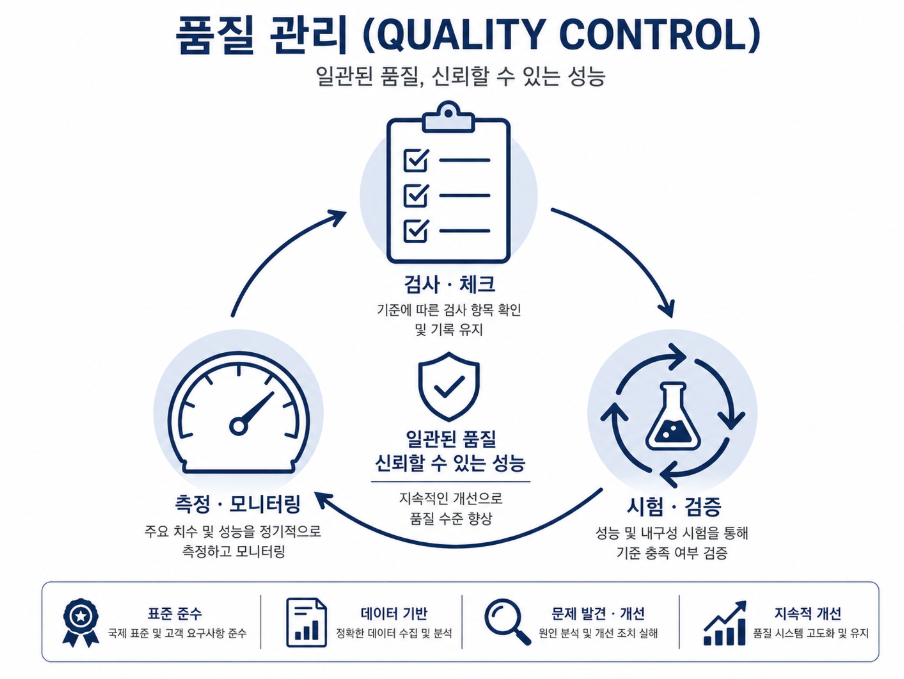
When we look back at the buyers who audited us hardest and became the longest-running accounts, their inspections — on-site or by video — consistently covered the same four areas. This is the audit that separates a real evaluation from a factory tour.
1. The manufacturer’s production line and welding shop
Frames are where commercial equipment lives or dies, so the welding shop is the heart of any audit. Look at whether critical joints are welded by robotic stations or skilled manual welders with jigs, and ask to see weld cross-section samples showing penetration rather than cosmetic surface beads. Check the raw material area: steel tube stock should be organized, labeled with gauge and grade, and traceable to mill certificates. Watch the line for work-in-progress consistent with the factory’s claimed capacity — a plant that claims 200 machines a month but shows three half-built frames and a quiet floor is telling you its real role. The deeper story of what separates commercial-grade construction from home-grade, from steel gauge to coating, is one we tell in a dedicated factory-view guide, and it is exactly the checklist to bring to this part of the audit.
2. The manufacturer’s QC process and testing equipment
Production capability without quality control produces fast defects. Ask to see the QC system as a process, not a poster: incoming inspection of steel and purchased components, documented checkpoints between welding, coating, and assembly, and final inspection records for a real recent order. Then ask for the testing equipment — this is where serious factories separate from assemblers. Load-testing rigs, fatigue and life-cycle testing machines that run a station through tens of thousands of cycles, and salt-spray chambers for coating durability are physical investments a trading company or a shed operation simply does not have. Ask to see a test running live. We have never had a good buyer skip this room, and we have never had a bad one ask for it.
3. The manufacturer’s certificates: verify, don’t just view
Every supplier will show you certificates; the audit is in checking them. For the quality management system, the relevant credential is ISO 9001, and a genuine certificate names an accredited certification body, carries a certificate number you can verify directly with that body’s online registry, shows current validity dates, and is issued to exactly the company name on the business license. For the products themselves, ask for ISO 20957 test reports for the specific machine classes you are buying, and CE documentation if you are importing into the European market. The failure modes we see repeatedly from the buyer side: certificates issued to a different company (the trader is showing you the factory’s papers), expired certificates presented as current, and outright edited PDFs. Five minutes on a certification body’s verification page catches all three.
4. The manufacturer’s export records and customer references
The final quadrant is track record. A manufacturer that genuinely exports can show customs export records, container-loading photos with dates and identifiable products, and shipping documents for markets like yours — and can connect you with reference customers in your region who will take a call. Repeat-order history is the single strongest signal in this category, because distributors and chains do not reorder from factories that failed them. Be appropriately skeptical of famous-brand OEM claims; they are common, occasionally true, and only meaningful when backed by something verifiable.
| Audit area | Ask to see | Red flag |
|---|---|---|
| Production & welding | Live line, weld cross-sections, steel storage with mill certs | Quiet floor, cosmetic welds, unlabeled stock |
| QC & testing | Fatigue/load test rigs running, documented checkpoints | “Testing is done at another site” |
| Certificates | ISO 9001 with verifiable number, ISO 20957 reports, CE files | Name mismatch, expired dates, edited PDFs |
| Export record | Customs records, loading photos, regional references | No references, unverifiable brand claims |
Auditing a gym equipment manufacturer in China: video, on-site, or third-party
Not every order justifies a flight to China, and the good news is that the four-part audit above compresses surprisingly well into a structured video call. The protocol that works, based on the calls we host: first, insist the walkthrough is live and uninterrupted, not a pre-recorded video. Second, direct the camera yourself in real time — into the welding shop, onto a nameplate serial, across the testing room, down the raw-material racks. Third, ask for spontaneous documents on screen: this week’s production schedule, the mill certificate for that specific stack of tube, the ISO certificate number held up to the lens for you to verify afterward. Fourth, ask a worker on the line, through your host, what they are building and for which order. Fifth, request that one of your candidate machines be pulled aside and put through a load test while you watch. A factory finds all five requests routine; we host these calls weekly and have never lost an order by saying yes to one. Pre-recorded tours and endlessly rescheduled “the factory is busy today” calls are answers in themselves.
On-site visits earn their cost when the order size does — as a rule of thumb, when you are committing container-level volume or setting up a long-term OEM program — because only your own eyes catch atmosphere: how organized the floor is, how workers handle parts, whether the office and the factory feel like one company. In between sits the third-party audit, and it is the most underused tool available to smaller buyers. International inspection firms such as SGS, TÜV, Bureau Veritas, and Intertek run standardized factory audits across China, typically taking one to three days on-site and costing on the order of $1,000–$2,500 — a rounding error against a $60,000 equipment order, and the auditors have seen every trick a supplier can pull. For buyers who cannot travel, a third-party audit plus a self-directed video walkthrough covers most of what a visit would.
Red flags when vetting a gym equipment manufacturer in China
Across years of watching buyers evaluate us and our competitors, the same warning signs precede most bad outcomes. A price dramatically below the cluster norm for the same specification is the most reliable one — steel, motors, and skilled welding have real costs, and a quote that ignores them will recover the difference somewhere you cannot see. A product catalog that sprawls across unrelated industries, gym equipment beside furniture beside solar panels, marks a trader, not a manufacturer. Refusal or endless rescheduling of a live video walkthrough speaks for itself. Certificates that fail verification, in any of the ways described above, should end the conversation rather than prompt an explanation. An address that differs between the license, the website, and the shipping documents is a masquerade coming apart. And sample quality that mysteriously exceeds production quality is common enough that experienced buyers photograph and mark their approved samples, then hold shipments against them — a practice we cover alongside the other classic errors in our guide to the costliest mistakes when buying gym equipment from China. One more that costs buyers real money: payment instructions that route funds to a personal account, or to a company name that does not match the license and the contract. Legitimate manufacturers are paid into the corporate account of the entity you contracted with, full stop, and any “our boss’s account is faster” arrangement removes every protection you have.
None of these flags is exotic. The buyers who get burned almost always saw at least one of them and proceeded anyway, usually because the price was good. The price is always good.
After vetting your gym equipment manufacturer in China: sample, then scale
Once a manufacturer has passed the audit, the path forward is the standard one: order a sample of your key machine, evaluate it against the specification, and only then commit volume — with the specification, terms, and warranty put in writing as covered in our main guide to buying commercial gym equipment from China. Vetting does not eliminate the need for those contractual protections; it just means you are negotiating them with a real counterparty.
We will close with the offer that this entire article implies. We are a gym equipment manufacturer in the Yangtze River Delta, and everything above is an audit we are prepared to pass on a live call: the welding shop, the testing room, the certificates with verifiable numbers, the export records. If you are building a supplier shortlist, put us on it, ask us the hard questions, and judge the answers — we would rather earn an order from a buyer who checked than win one from a buyer who didn’t.
References
- International Organization for Standardization — ISO 9001:2015, Quality management systems — Requirements. https://www.iso.org/standard/62085.html
- SGS — Factory Audit Services (China). https://www.sgsgroup.com.cn/en-cn/showcases/factory-audit-services
- IWF Shanghai — China (Shanghai) International Health, Wellness & Fitness Expo, official site. https://www.ciwf.com.cn/en/
